1/1
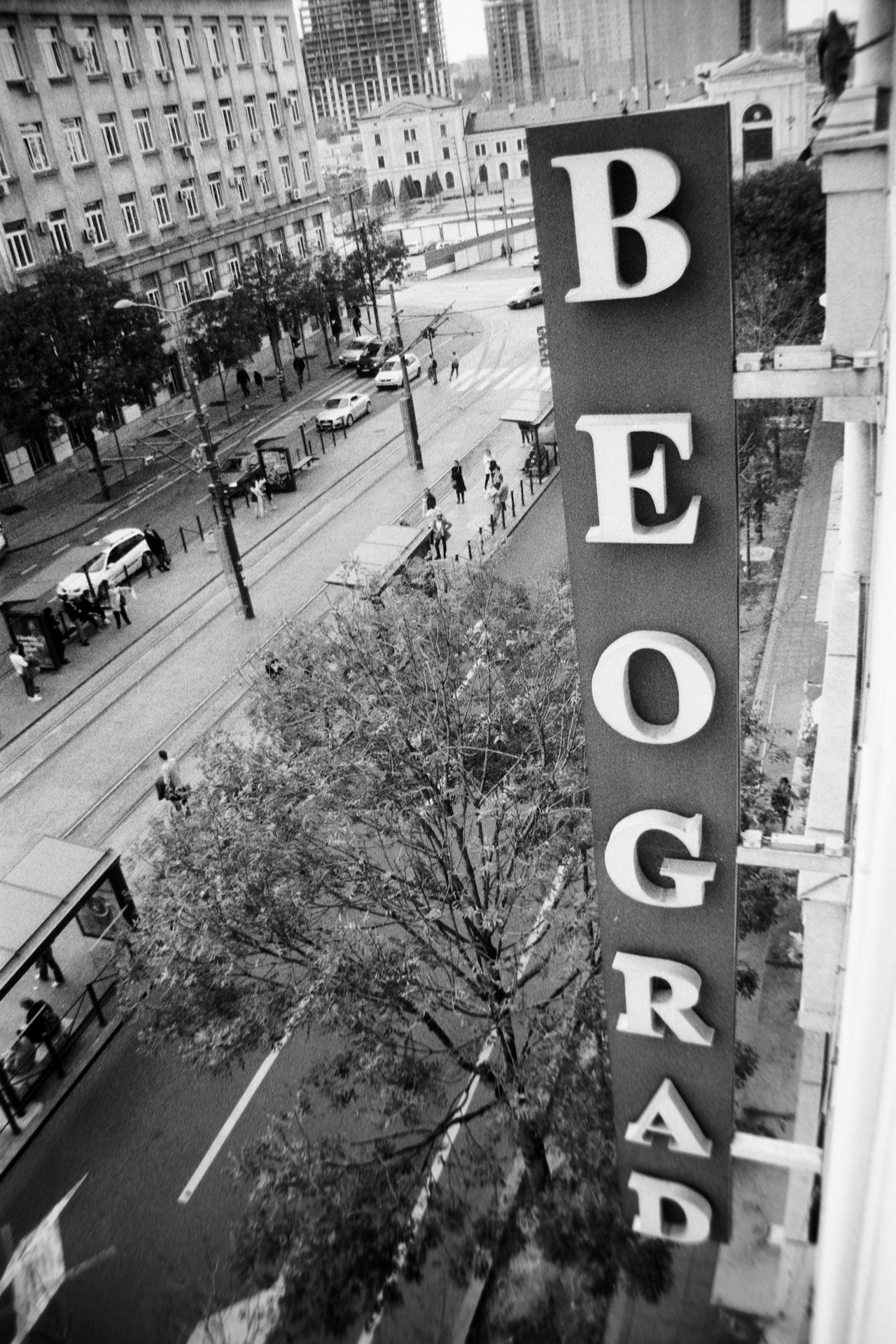
Spiritual Destination, 2021
Analogue photography
Digital fine art archival print, framed 85x60cm
BELGRADE IN THE PAST AND PRESENT - REVISITED
Good value for money
The Industrial Revolution, with its new forms of production and markets, marked a civilizational turning point thatwould reshape the face and structure of the city, as well as life within it. From the early modern era to the present,the city, as a dominant urban habitus, has been one of the most persistent creative obsessions of artists, with itsgrowth and transformations meticulously documented and critically examined. As Paul Arden1 wrote, “The drivingelement of modernist imagination, a mental palimpsest that reconciles order and chaos, organization and entropy,in short, the urban environment naturally inherent to Western culture, appears to belong to art more than any otherentity.” Elaborating further on the city-art relationship, through a series of specific examples, Arden points to certainartistic practices throughout the 20th century that, rather than being confined to traditional studio settings, emergedthrough actions within and in conjunction with the urban space, utilizing the city as a medium for artistic processesand activities.Recognized as a particularly problematic field, the phenomenology of the city has long been represented in museum andgallery programs. During the last decades of the 20th century, the Sales Gallery Beograd aimed to “revive the historicalmap of the city and a more nostalgic projection of urban space that is disappearing before our very eyes”2 by a series ofcurator-led initiatives and exhibition activities. In accordance with its position within the system of institutions underthe auspices of the City of Belgrade, its founding mission, and the fact that it shares the same roof with artists’ studios,as a veritable cultural hub for gatherings, nurturing this programmatic discourse and responding to the need for itsrevitalization appears both logical and professionally binding. Over time, the gallery has taken on the role of a custodianof cultural heritage and environmental integrity of Kosancicev venac, as the oldest and historically layered core of thecity’s heart, promoting local cultural values and celebrating the city as a whole while the cycles of exhibitions Belgradein the Past and Present have a special place in its exhibition chronology. In its initial manifestations, the exhibitionprimarily aimed to connect temporally distant artistic visions of a single space within a traditional genre framework.However, the subsequent social, political, and cultural transitions that followed the turbulent war marked 1990s, havemade globalization trends more pronounced and visible, leaving their marks on the shaping and perception of thecity. The contemporary art production, as a litmus test of such transformations, has necessitated the presentation ofdifferent media and conceptual approaches, theoretical and critical insights, as manifested by the last aforementionedexhibitions, curated by art historians Marko Stamenkovic (2005) and Sava Ristovic (2006).
As far as future projections regarding the positions and visual identities of the city, as well as its reception in artisticpractices, there remain open questions regarding the potentials of the urban space configured to align with thefunctional needs of its individual and collective constituents. How will the growth of the city unfold: organically, withinacceptable limits, or will there be a disbalance between the nucleus of cultural and historical heritage and the expansionsteered by the established frameworks and goals of dominant economical and socio-political matrices? Is the dreamof the city a utopia of harmonious coexistence or a dystopian vision of a hybrid form of archaism and ultra-modernity,as written by Mark Fisher? Is there an alternative for the citizen, in relation to his/her role as a passive and objectifiedobserver-consumer within such a construct based on the connection between ideological-traditionalist ressentment andthe paradigm of progress emerging from lucrative projects in local and global flows of capital?
Miroslav Sapundzic
1 Pol Arden, Kontekstualna umetnost, Umetnicko stvaranje u urbanoj sredini, u situaciji, intervencija, ucestvovanje (Contextualized Art,Creation of Art in an Urban Surrounding, in a Situation, Intervention, Participation), Izdavacka kuca KISA, Muzej savremene umetnostiVojvodine, Novi Sad, 2007, 96.
2 Jelena Krivokapic, „Beograd nakad i sad 2005, evolucija shvatanja urbanog pejzaza, (Belgrade in the Past and Present, 2005,Evolution of our Perception of an Urban Landscape), Prodajna galerija „Beograd“, 2005, 3.