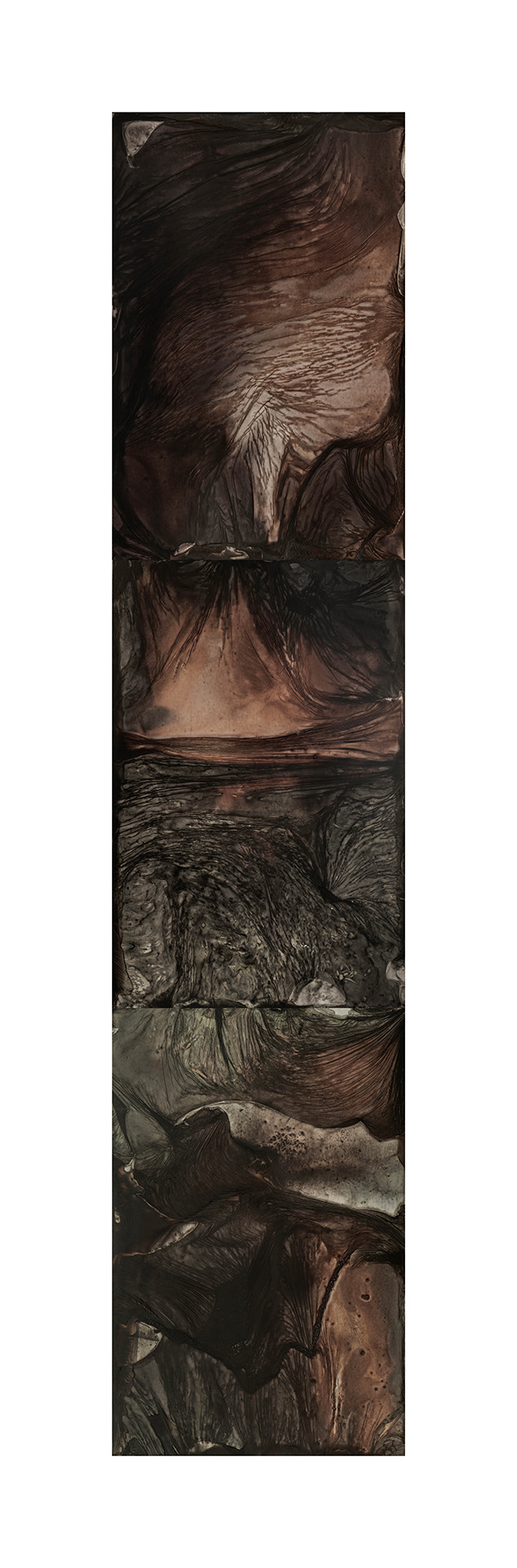
Work explores the image as an unstable space, subject to change, disintegration, and reconfiguration. The work approaches entropy as a process of increasing disorder and transition from one state to another, in which destruction is understood not as an endpoint, but as a possibility for the emergence of a new order.
The work is created through mordançage, a chemical process in which an already formed photographic image is subjected to further transformation. The emulsion is chemically eroded, separates from its support, and partially disappears, while the original photographic record becomes the material from which a new image emerges. The loss of the original structure thus becomes a condition for the emergence of another.
Establishing a kind of space within a space, materially present yet without a stable geography, scale, or center, the work questions the boundary between the photographic record and its physical transformation. The image ceases to function solely as a representation of reality and becomes an autonomous material structure, whose form emerges through the process of disintegration.
This understanding of the image can be related to the philosophy of Gilles Deleuze, particularly his concept of becoming, according to which identity and form are not necessarily fixed categories, but are shaped through continuous processes of change and differentiation. In this context, the photographic image does not represent the final outcome of a process, but rather a temporary state of matter open to further transformation. Mordançage does not merely produce an altered version of the original photograph; it enables the emergence of a new visual structure whose identity is no longer based exclusively on what was previously represented.
Throughout this process, chance and control continuously alternate. The chemical reaction opens up possibilities that cannot be fully anticipated, while artistic intervention guides, but never entirely determines, the final appearance of the image. Photography thus ceases to be a fixed and immutable record, becoming instead a space of continuous transformation.
Entropy questions the possibility that disintegration signifies not only loss, but also the potential for the emergence of new visual relationships. The image takes shape precisely through the instability of its own materiality, opening up a space in which disintegration and formation, presence and disappearance, trace and transformation coexist.
Entropy, 2026.
Mordançage on photographic paper, 120x50cm
Reference:
Gilles Deleuze, Difference and Repetition (Différence et répétition, 1968).